
Your starting point
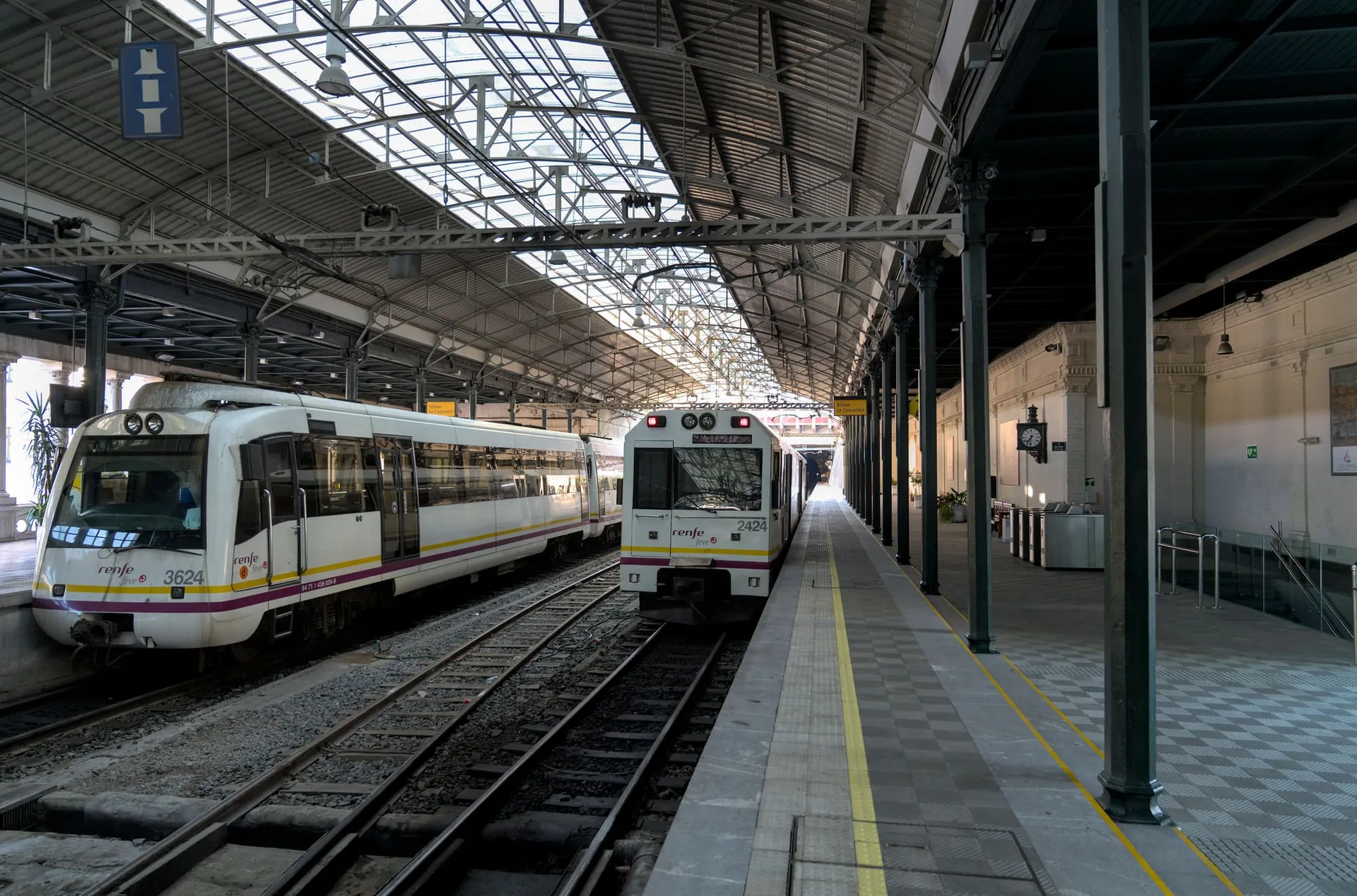
About 40 % of the German rail network has no catenary — mostly regional lines where full electrification does not pay. Battery trains solve this with short charging sections: a stretch of catenary or a charger at the terminus, battery running in between. The design question has teeth: how large must the battery be, how many charging sections, and where? And on rail, one thing matters above all: the timetable must always hold. In frost, on gradients, and when a vehicle is in the workshop.
What we compute
- Consumption from physics. We simulate every train longitudinally: mass, gradient, speed, acceleration, recovered braking energy. On real topography this is decisive. On one Bavarian line, the same section used about 2.5 kWh/km more uphill than downhill — at just half a percent of gradient.
- Scheduling with maintenance windows. We plan schedules with charging times and maintenance intervals built in from the start.
- Design as one joint computation. We size battery, charging sections, fleet and cost in a single optimisation. The target is the cheapest plan that holds the timetable on the worst day.
Our track record
Our team accompanied Germany’s first fully approved modern battery train into passenger service, together with Alstom. Over 8,400 km of trial operation, the train achieved 100 % reliability. The 30-year cost comparison came out about 20 % below diesel, with up to 98 % less greenhouse gas on renewable electricity.
Where this field stands
Rail is our youngest field. Consumption simulation and planning core are proven; the end-to-end optimisation of battery and charging sections for arbitrary lines is being built now. For that we are looking for a first line — and a partner who would rather have the answer right than fast.
Talk to us
If you have a diesel line where catenary does not pay, let us look at it together: topography, timetable, possible charging points.