
Your starting point
Whether to electrify has been decided: Germany’s clean-vehicle procurement law requires that from 2026 to 2030, 65 % of newly procured buses are clean, half of those zero-emission. What remains open is how: which battery sizes, which charging sites, which vehicle schedules, at what cost. These decisions depend on each other, and mistakes are expensive in both directions.
What the simulation answers
eFLIPS models your network completely, from timetable to grid connection. It answers the questions electrification planning hangs on:
- Vehicle schedules. Which of your existing schedules work electrically, and what does replanning gain? In the Berlin case, replanned schedules with small batteries needed fewer vehicles than diesel.
- Route ends. Which route ends need chargers, at what power? Or is depot charging enough?
- Consumption. How much energy does your network need on the design day? Computed with maps from real measurement runs: gradient, temperature, occupancy, speed.
- Depot. How many stands and chargers does each depot need, and what peak hits the grid connection? With charging management that caps expensive peaks.
- Cost and environment. What does each variant cost per kilometre, and what does it save in emissions? Diesel and electric sit side by side in the same run.
The software computes, your team steers
These answers come from your own simulation model. In the pilot project we build it together from your data and train your team on the graphical interface. After that, you change assumptions and recompute yourself: a new timetable, a different vehicle on the market, a rejected charging site.
Proven in Berlin, transferable to your network
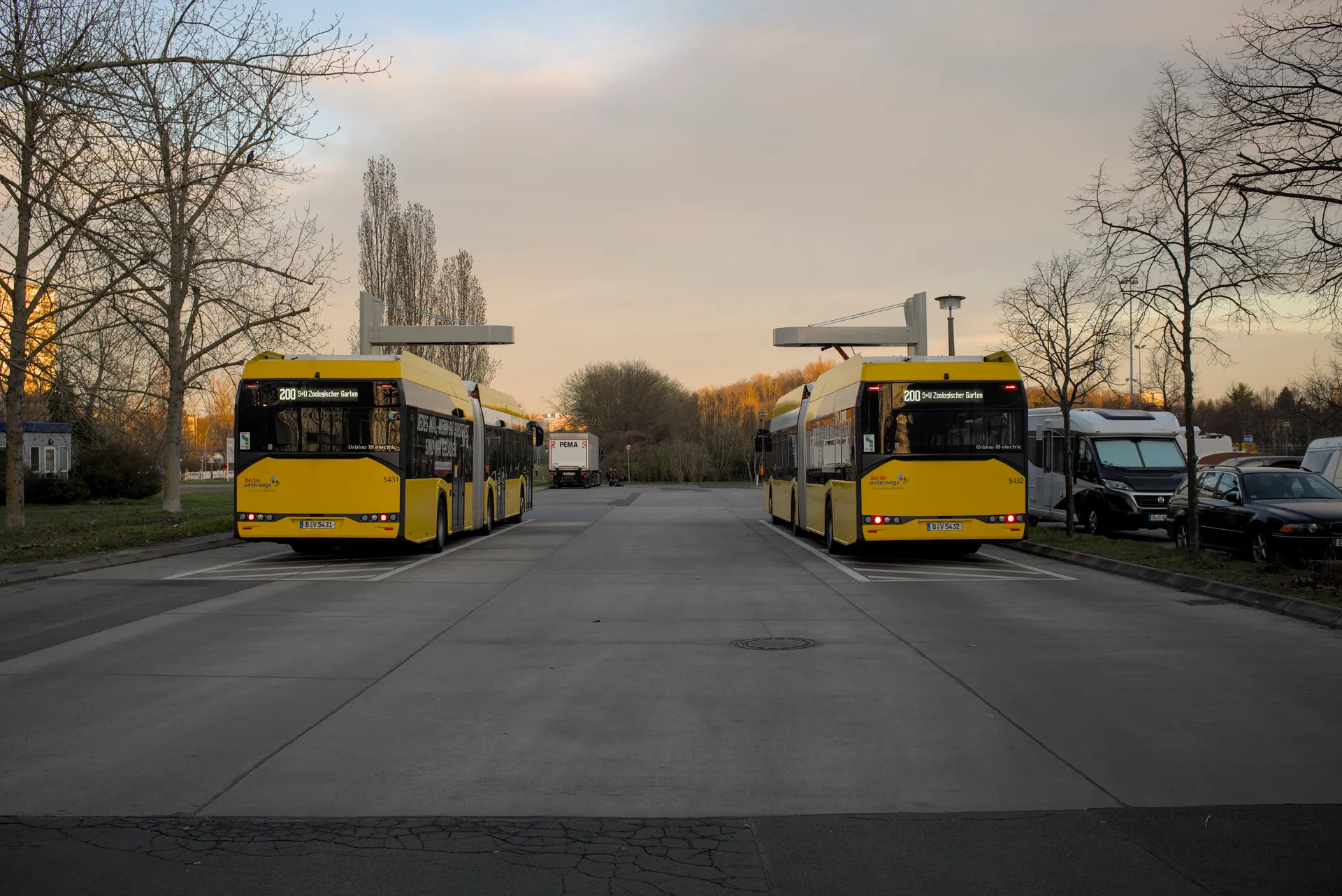
With BVG, Germany’s largest bus operator, we compared three electrification strategies for the whole network:
| Strategy | Route ends | Fleet vs. diesel |
|---|---|---|
| Existing schedules, route-end charging | 49 | +4 % |
| Depot charging only | 0 | +7 % |
| Small batteries, dense charging | 117 | −2 % |
No strategy wins everywhere. Which one fits you depends on your land, your grid and your costs.
We compute smaller networks with the same tool. For the Ulm network, with a good 100 vehicles, our result matches an independent feasibility study — set up from public timetable data and a terrain model alone.
The data you have is enough
We work with what you have: scheduling and timetable data in VDV format or as GTFS. No data project is needed, and first results for a mid-size network arrive within hours, not months.
Become a pilot partner
We are taking on a small number of pilot partners in 2026/27. Whether it is a feasibility check for your first depot or a strategy comparison for the whole network: bring your question. Pilot partners help decide which features we build first, and keep favourable terms permanently.